
The Jackbox Party Pack 9
Save your next party! 5 new games in 1 Party Pack: the trivia bluff-off Fibbage 4, the team test Quixort, the joke auction Junktopia, the silly guessfest Nonsensory and the reality TV game Roomerang.
Sync your Steam wishlist to find the lowest game prices instantly. No login required, just paste your Steam profile URL!
⚡ Try Wishlist Radar!
Sync your Steam wishlist to find the lowest game prices instantly. No login required!
⚡ Try Wishlist Radar!
Close

What The Dub?! on Steam
Quick menu
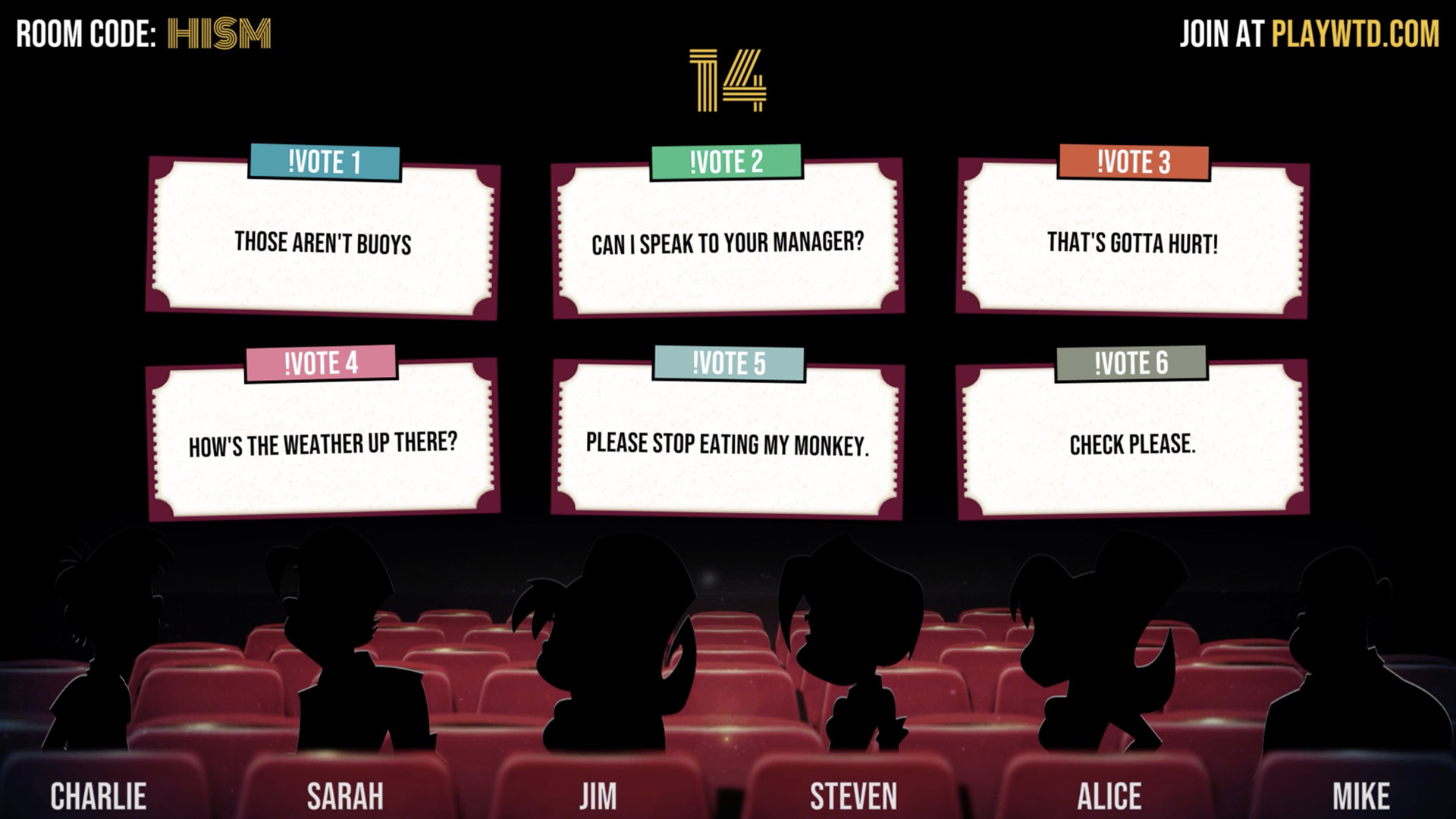
What The Dub?! is a multiplayer party game where each player overdubs missing dialogue from hilariously awful B-movies, outdated PSAs, and bizarre industrial films, with their own witty (or just plain stupid) dubs!
What The Dub?! is a casual, board game and trivia game
developed by Wide Right Interactive, Mark Zorn and Kurt Wojda
and published by Wide Right Interactive.
Released on April 08th 2021 is available on Windows, MacOS, Steam Deck and Steam Machine.
It has received 353 reviews of which 331 were positive and 22 were negative resulting in a rating of 8.6 out of 10. 😎
The game is currently priced at 7.99€ on Steam.
The Steam community has classified What The Dub?! into these genres:
Media & Screenshots
Get an in-depth look at What The Dub?! through various videos and screenshots.




Load More


System requirements
These are the minimum specifications needed to play the game. For the best experience, we recommend that you verify them.
Windows
- OS: Windows 10
- Processor: 2.66 Ghz Core 2 Duo or Greater
- Memory: 4 GB RAM
- Graphics: GeForce 500+ / Radeon 5000+ or Greater
- Network: Broadband Internet connection
- Storage: 1250 MB available space
- Additional Notes: Windows 7 and 8 are not supported.
MacOS
- OS: 10.12+
- Memory: 4 GB RAM
- Network: Broadband Internet connection
- Storage: 1350 MB available space
Steam Price & Best Deals
User reviews & Ratings
Explore reviews from Steam users sharing their experiences and what they love about the game.
What The Dub?! is a party game built around a simple but highly effective idea: take awkward footage from B-movies, outdated public service announcements, and strange industrial films, remove part of the dialogue, and allow players to write their own replacement lines. Developed by Wide Right Interactive, Mark Zorn, and Kurt Wojda and published by Wide Right Interactive, it turns old-fashioned footage into a framework for improvisational comedy. Instead of relying on traditional objectives, reflexes, or complicated rules, the entertainment comes from the personalities of the people playing and their ability to transform an otherwise serious scene into something completely ridiculous. Each round presents a video clip containing missing dialogue. Players watch the setup and then submit whatever line they believe will produce the funniest result. Those responses are converted into speech and inserted into the footage, allowing the characters on screen to effectively perform the players' jokes. Everyone then votes for their favorite submission, with points awarded accordingly. The concept takes only moments to understand, making it especially suitable for groups containing people who rarely play video games. There is essentially no mechanical learning curve, although becoming good at the game means learning what kind of humor appeals to the particular group. The use of vintage and low-budget footage is one of its strongest creative decisions. Rather than functioning as an incidental visual backdrop, these strange films provide most of the setup for the comedy. Awkward acting, overly dramatic expressions, dated clothing, unusual editing, and unintentionally funny situations give players plenty of material to exploit. With more than 600 clips forming the core selection, there is enough variety to keep sessions moving without immediately exhausting the available material. Steam Workshop support further strengthens replayability by providing access to community-created clip packs, which can refresh the experience once the standard collection becomes familiar. Text-to-speech adds another important layer to the humor. Reading a funny response on a screen would work, but actually hearing a submitted line delivered alongside the original footage creates a much stronger punchline. The occasionally unnatural character of synthesized speech can even enhance the comedy. Extensive text-to-speech language support also makes the underlying concept accessible to a broader variety of groups. Since the humor itself is created by participants rather than being completely scripted by the developers, different groups can produce radically different experiences from identical footage. The multiplayer setup is intelligently designed for social gatherings. Up to six players can participate directly in creating dubs, while additional audience members can join the voting process. Participants use browser-enabled phones, tablets, or computers to enter responses and vote, eliminating the need to provide everyone with a conventional controller. Only the host needs to operate the main game. This makes setting up a local session considerably easier than party games that require numerous controllers, although everyone having access to a suitable connected device remains necessary. Remote play is possible as well, but it requires more organization because remote participants need to see and hear the host's screen to understand the clips they are dubbing. Screen sharing, video conferencing, or Steam's Remote Play Together functionality can therefore be incorporated into online sessions. The experience remains functional in this format, but local play arguably captures the concept at its best. Hearing everyone react simultaneously to an unexpectedly absurd line is an important part of the appeal, and that immediate social atmosphere can be difficult to reproduce perfectly online. Streaming support gives the formula another useful dimension. Twitch audiences can participate through voting, allowing the concept to work as interactive entertainment rather than merely something watched passively. Moderation and content-management options are particularly valuable because unrestricted player-written dialogue can quickly become problematic during public broadcasts. These tools acknowledge the unpredictable nature of user-generated humor without undermining the freedom that makes the premise entertaining. Presentation is deliberately straightforward. The interface primarily exists to facilitate the clips, submissions, playback, and voting rather than competing for attention. The wildly inconsistent quality of the archival footage effectively becomes the visual style, and that works surprisingly well. Cheap production values and outdated filmmaking techniques frequently make a scene funnier before anyone has even submitted a joke. Audio follows the same philosophy, using the contrast between existing movie dialogue and synthesized replacement speech to create much of the comedic effect. Its greatest limitation is also unavoidable: the quality of a session depends heavily on the participants. A creative group comfortable with improvisation can turn even an ordinary clip into something memorable, while quieter players or groups with very different senses of humor may struggle to generate the same energy. Voting can also become predictable when friends repeatedly favor particular styles of jokes. Long-term repetition is another concern because prerecorded footage inevitably becomes recognizable, although the substantial clip selection and Workshop integration help extend its longevity. Steam Deck is a practical option for hosting the experience. Steam currently classifies the game as Steam Deck Verified, making it a particularly appealing portable setup for gatherings. Its fundamental design also complements handheld use because most participants interact through their own browser-enabled devices rather than sharing the Deck itself. There can be considerations when using additional external controllers, but the central gameplay does not demand complicated controls or intensive handheld interaction. What ultimately makes the experience successful is its willingness to let players become the entertainers. The game supplies the setup, footage, speech system, voting structure, and social framework, but the participants determine whether a round becomes hilarious or forgettable. The enormous collection of strange clips, straightforward browser-based participation, Workshop support, remote options, audience voting, streaming features, and multilingual text-to-speech give a seemingly basic idea impressive flexibility. It is not a party game that guarantees laughter automatically, but with friends who enjoy improvisation and absurd humor, it can generate genuinely unpredictable moments that scripted comedy could never reproduce. Rating: 8/10
Similar games
View all

The Jackbox Party Starter
Get the party started with The Jackbox Party Starter! Featuring three updated titles: Quiplash 3, Trivia Murder Party 2 and Tee K.O., this starter pack is sure to entertain!

The Jackbox Survey Scramble
Discover how people across the country think! The Jackbox Survey Scramble is a collection of hilarious survey-based game modes, using real one-word answers from real people. Really! Grab some friends and start guessing!

The Jackbox Party Pack 11
The pack is back! The Jackbox Party Pack 11 transports your game night with 5 new games! Destroy wholesome jokes in Doominate, record your voice in Hear Say, create kookiness in Cookie Haus, sleuth through social clues in Suspectives, and collaborate with your crew in Legends of Trivia!
Frequently Asked Questions
What The Dub?! is currently priced at 7.99€ on Steam.
No, What The Dub?! is currently not on sale. You can purchase it for 7.99€ on Steam.
Yes, What The Dub?! received 331 positive votes out of a total of 353 achieving a rating of 8.63.
😎
What The Dub?! was developed by Wide Right Interactive, Mark Zorn and Kurt Wojda and published by Wide Right Interactive.
Yes, What The Dub?! is playable and fully supported on Windows.
Yes, What The Dub?! is playable and fully supported on MacOS.
No, What The Dub?! is not playable on Linux.
Yes, What The Dub?! is playable and fully supported on Steam Deck.
Yes, What The Dub?! is playable and fully supported on Steam Machine.
No, What The Dub?! does not support VR.
What The Dub?! offers both single-player and multi-player modes.
What The Dub?! offers both Co-op and PvP modes.
No, What The Dub?! does not currently offer any DLC.
Yes, What The Dub?! is fully integrated with Steam Workshop. Visit Steam Workshop.
Yes, What The Dub?! supports Remote Play Together. Discover more about Steam Remote Play.
Yes, What The Dub?! is enabled for Steam Family Sharing. This means you can share the game with authorized users from your Steam Library, allowing them to play it on their own accounts. For more details on how the feature works, you can read the original Steam Family Sharing announcement or visit the Steam Family Sharing user guide and FAQ page.
You can find solutions or submit a support ticket by visiting the Steam Support page for What The Dub?!.
Data sources
The information presented on this page is sourced from reliable APIs to ensure accuracy and relevance. We utilize the Steam API to gather data on game details, including titles, descriptions, prices, and user reviews. This allows us to provide you with the most up-to-date information directly from the Steam platform.
Additionally, we incorporate data from the SteamSpy API, which offers insights into game sales and player statistics. This helps us present a comprehensive view of each game's popularity and performance within the gaming community.
Last Updates| Steam data | 14 September 2026 21:21 UTC |
|---|---|
| SteamSpy data | 19 October 2026 00:40 UTC |
| Steam price | 19 October 2026 02:47 UTC |
| Steam reviews | 15 October 2026 05:57 UTC |
If you'd like to dive deeper into the details about What The Dub?!, we invite you to check out a few dedicated websites that offer extensive information and insights. These platforms provide valuable data, analysis, and user-generated reports to enhance your understanding of the game and its performance.
- SteamDB - A comprehensive database of everything on Steam about What The Dub?!
- SteamCharts - Analysis of What The Dub?! concurrent players on Steam
- ProtonDB - Crowdsourced reports on Linux and Steam Deck What The Dub?! compatibility


Game modes
Multiplayer
Features
Online players
6
Developer
Wide Right Interactive,
Mark Zorn,
Kurt Wojda
Publisher
Wide Right Interactive
Release
08 Apr 2021
Platforms
Remote Play