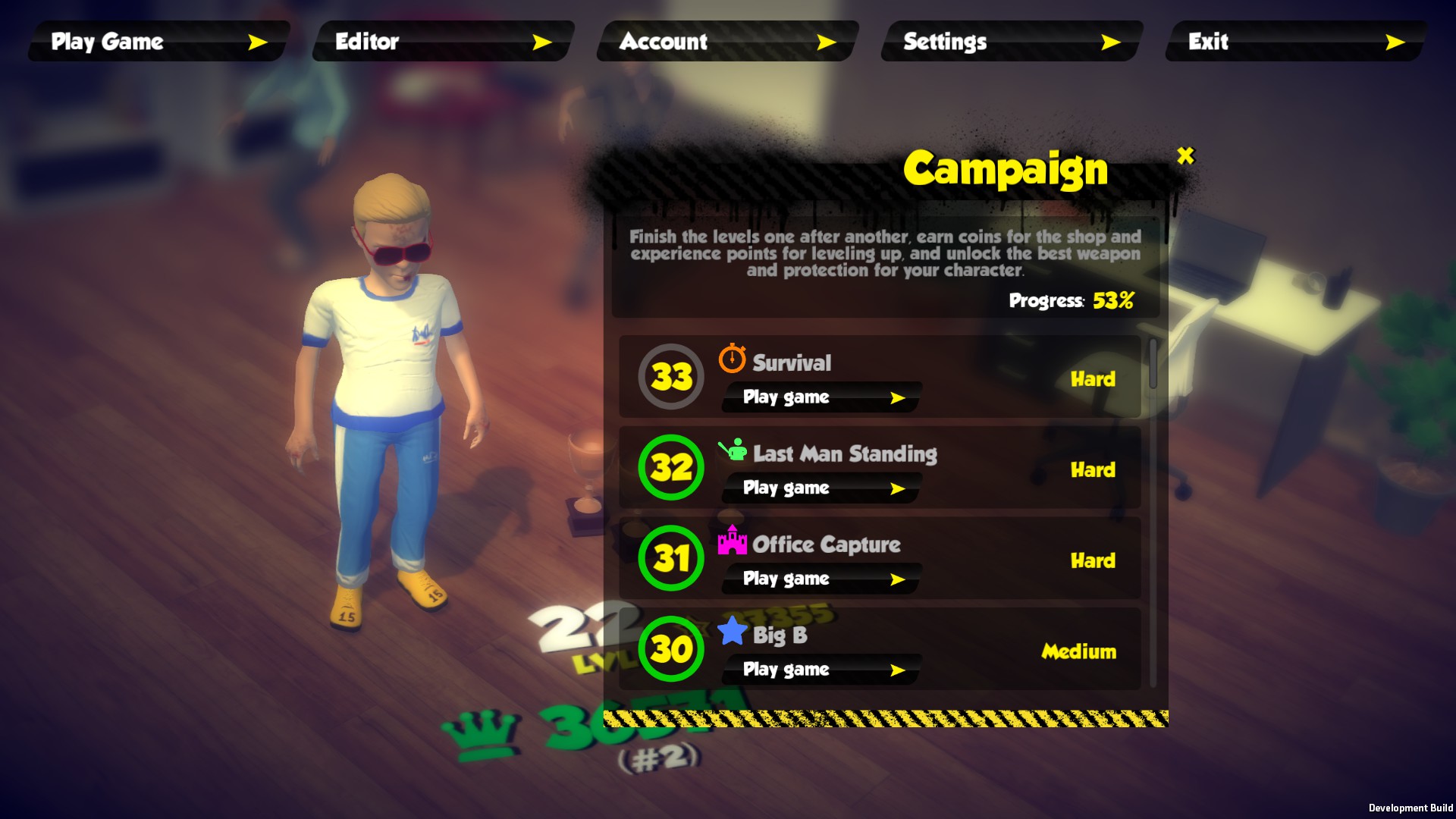
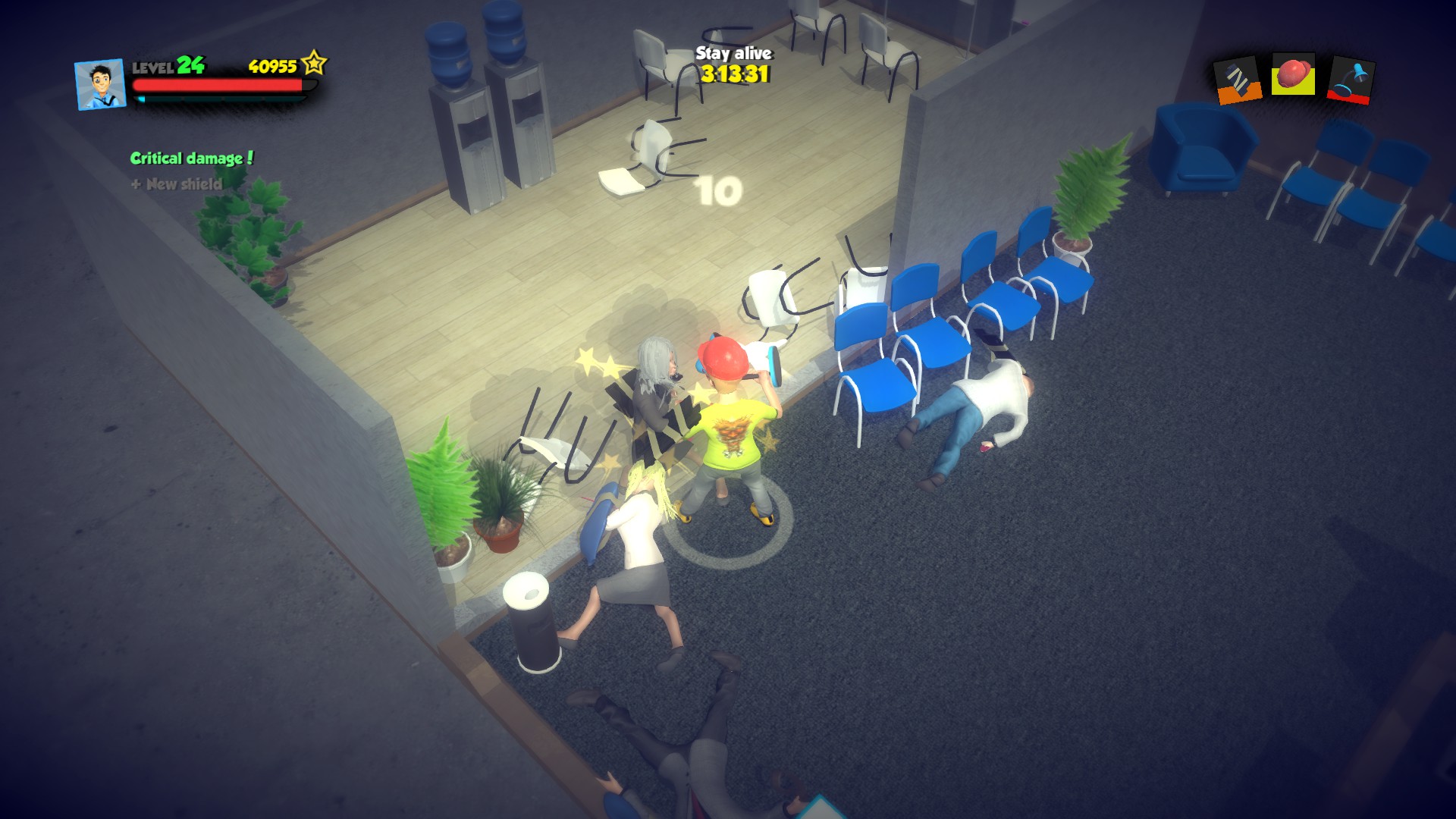
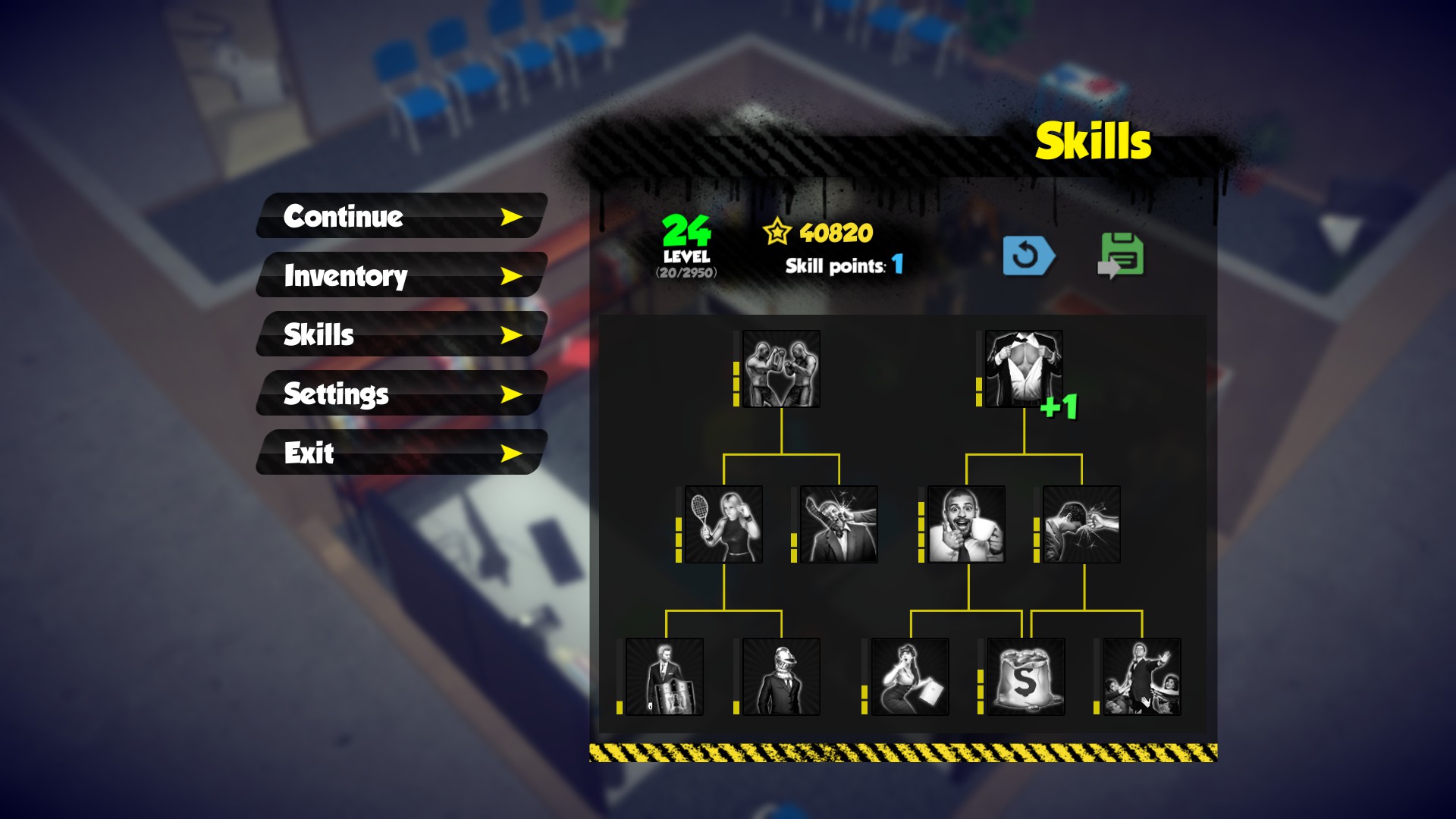
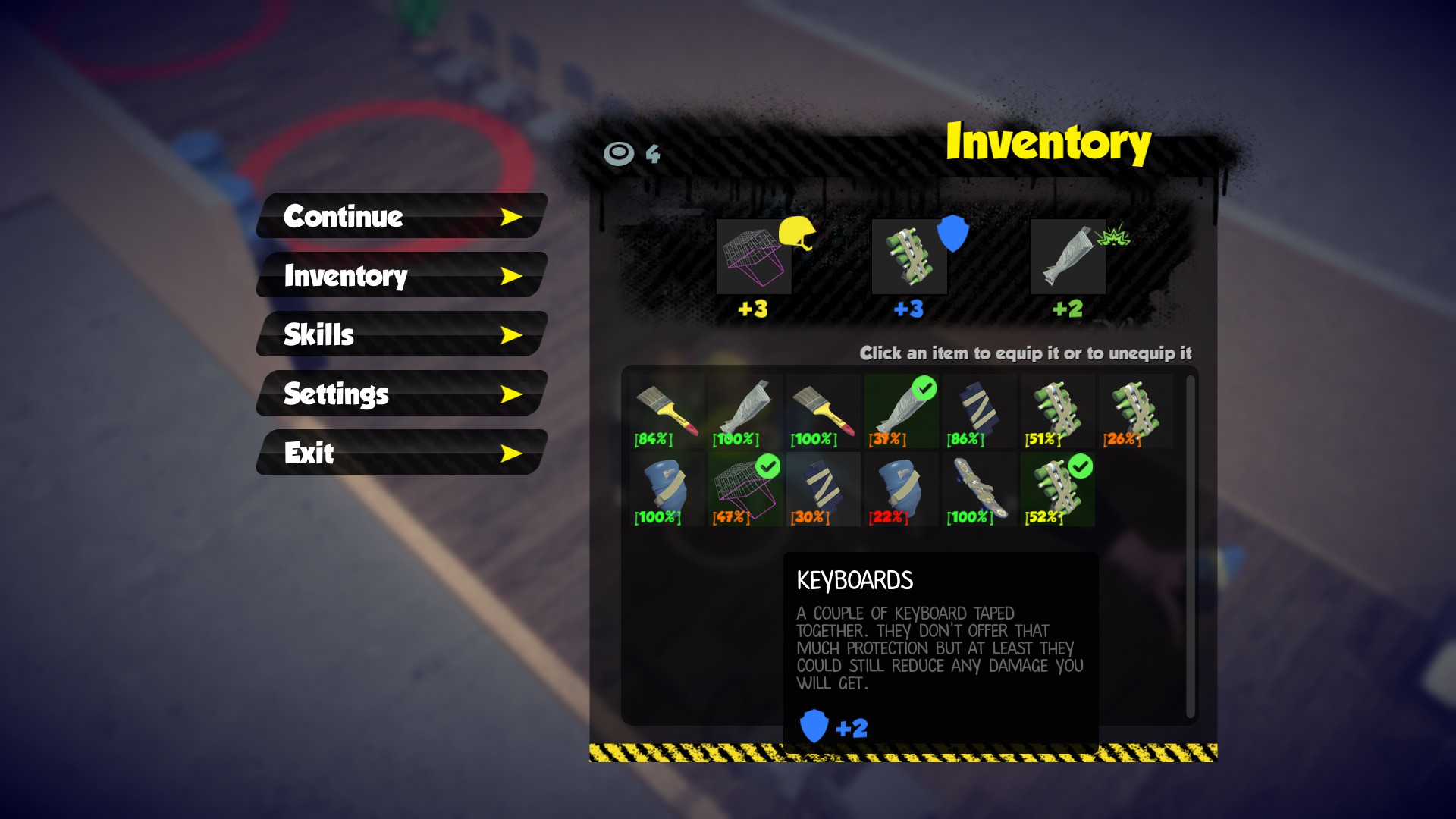
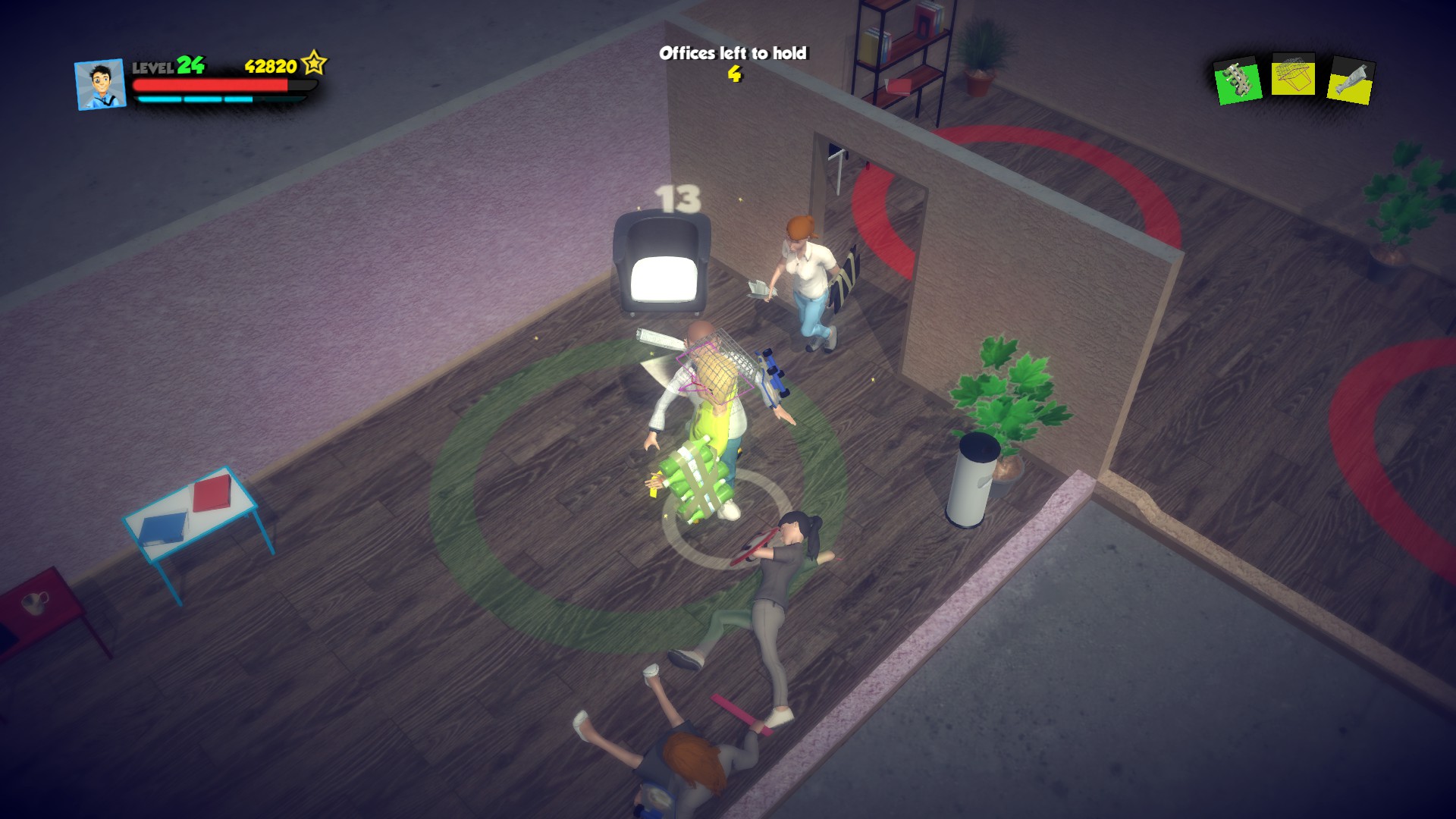
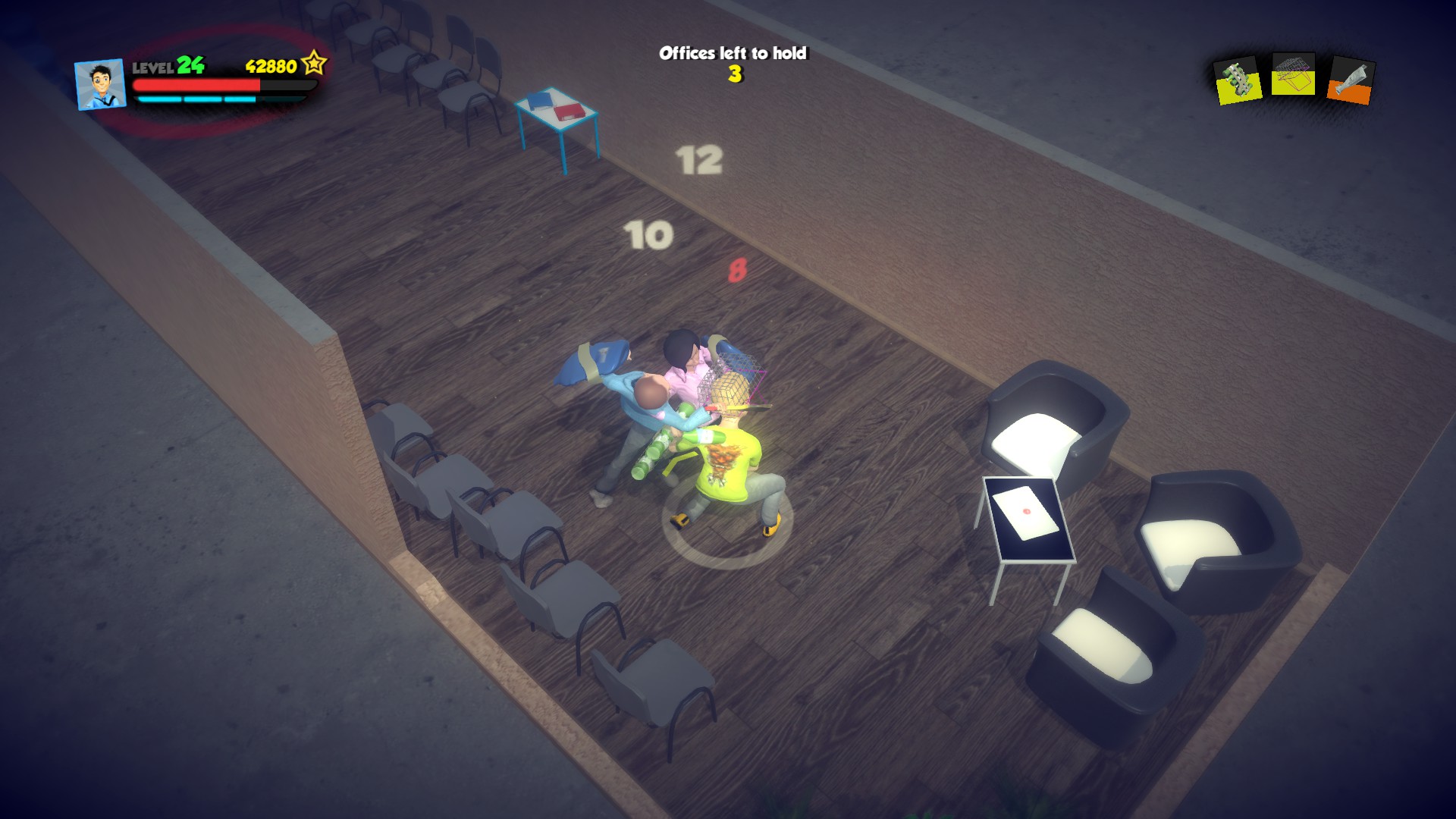
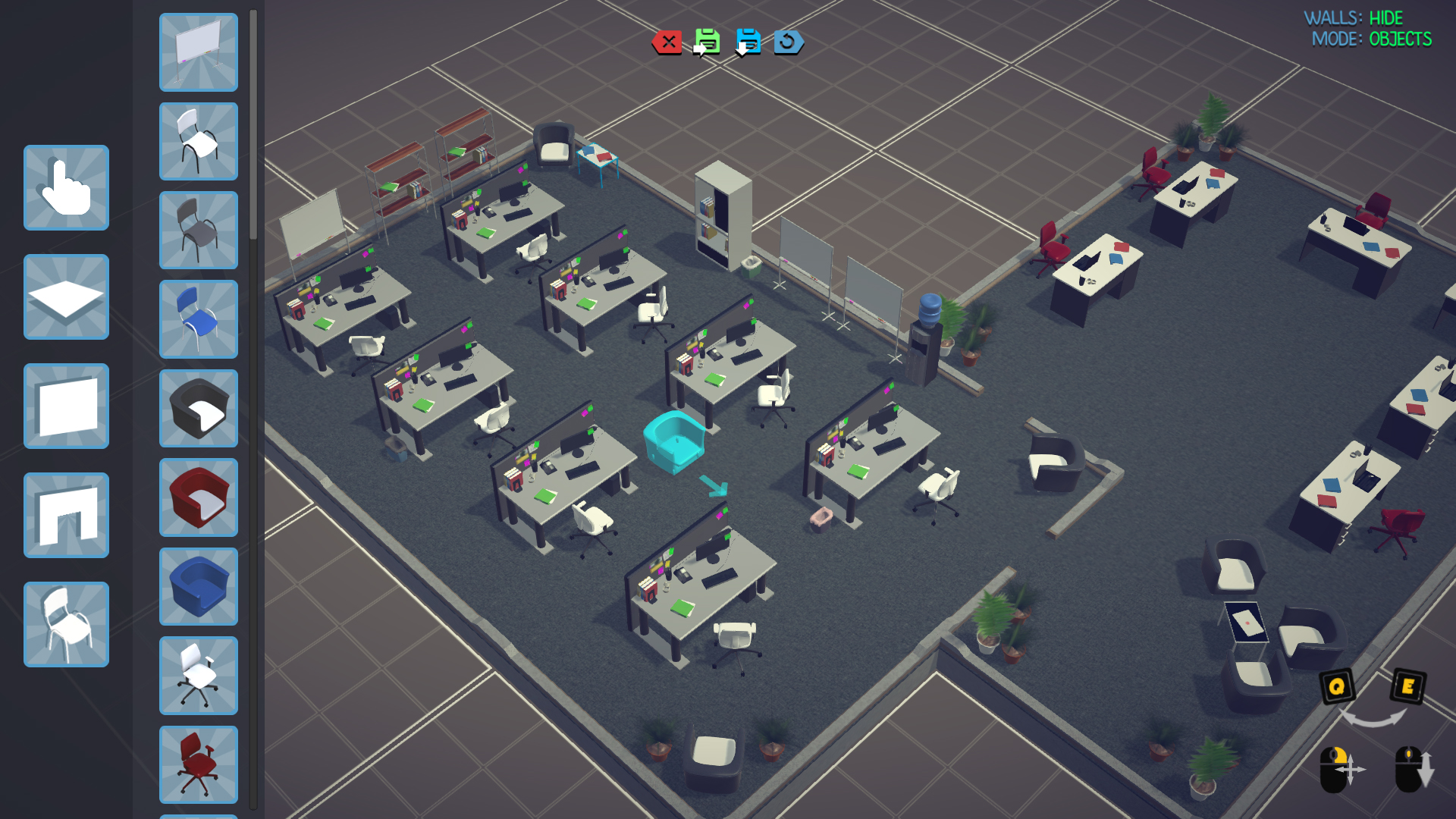
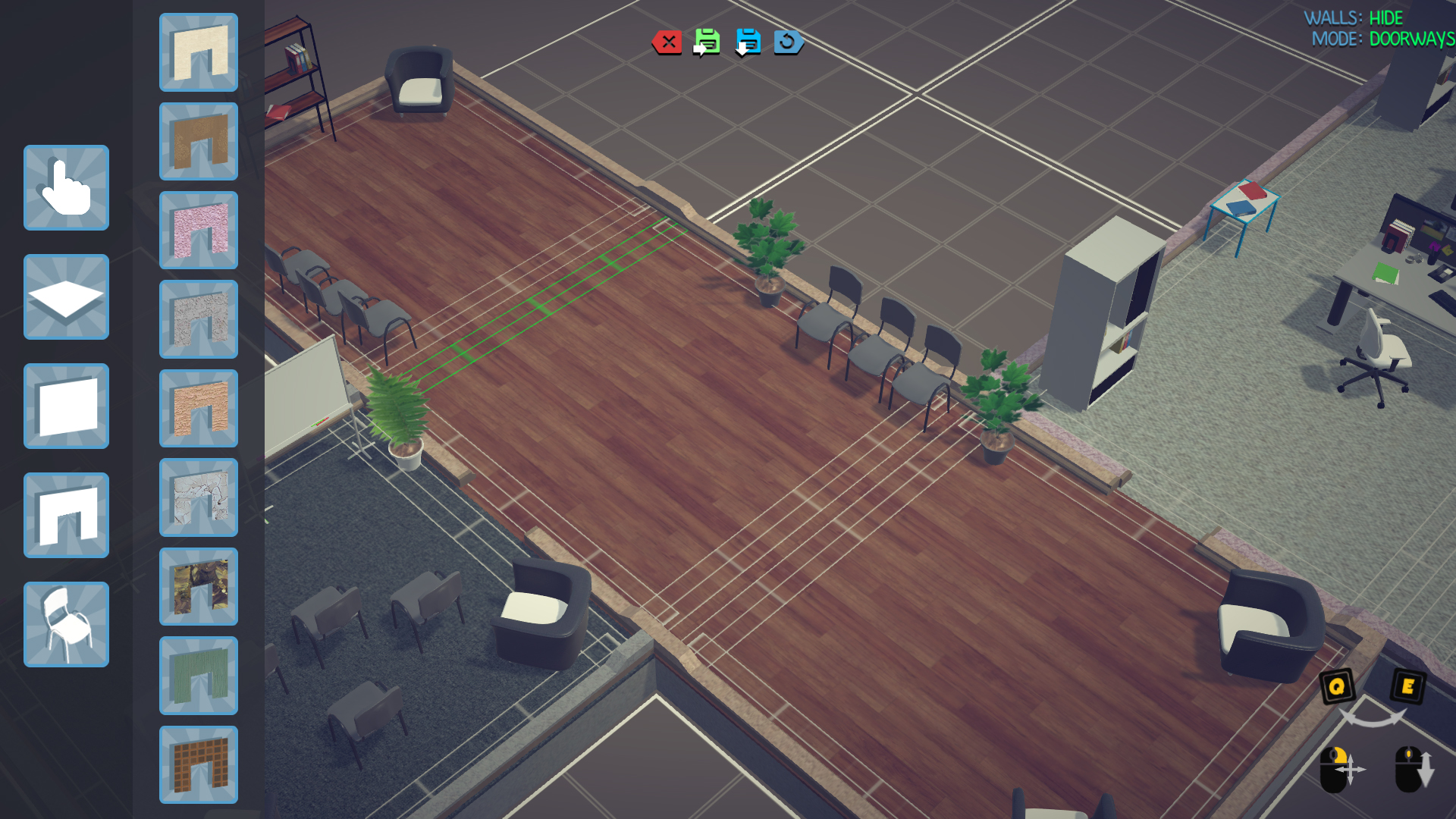
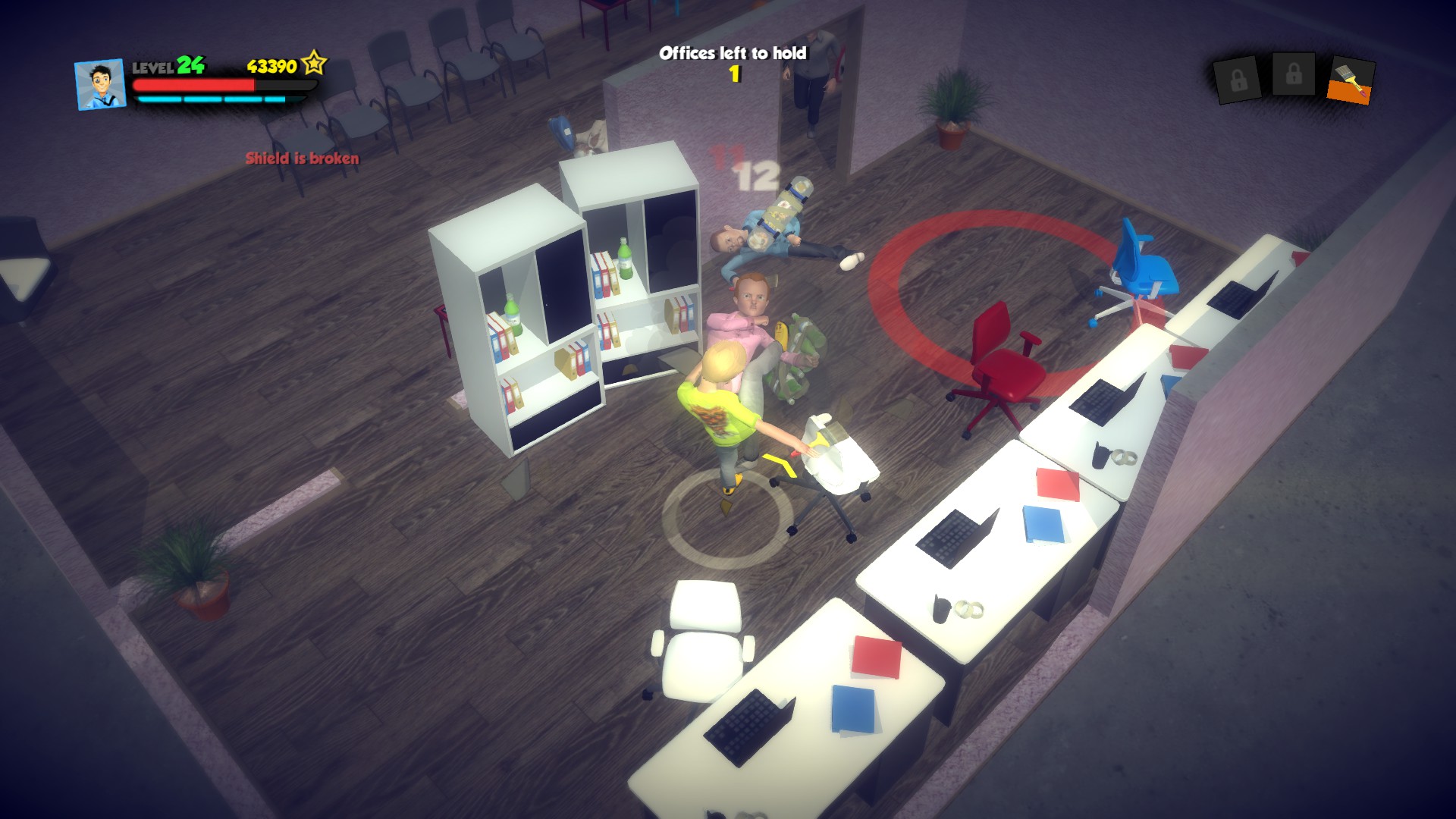
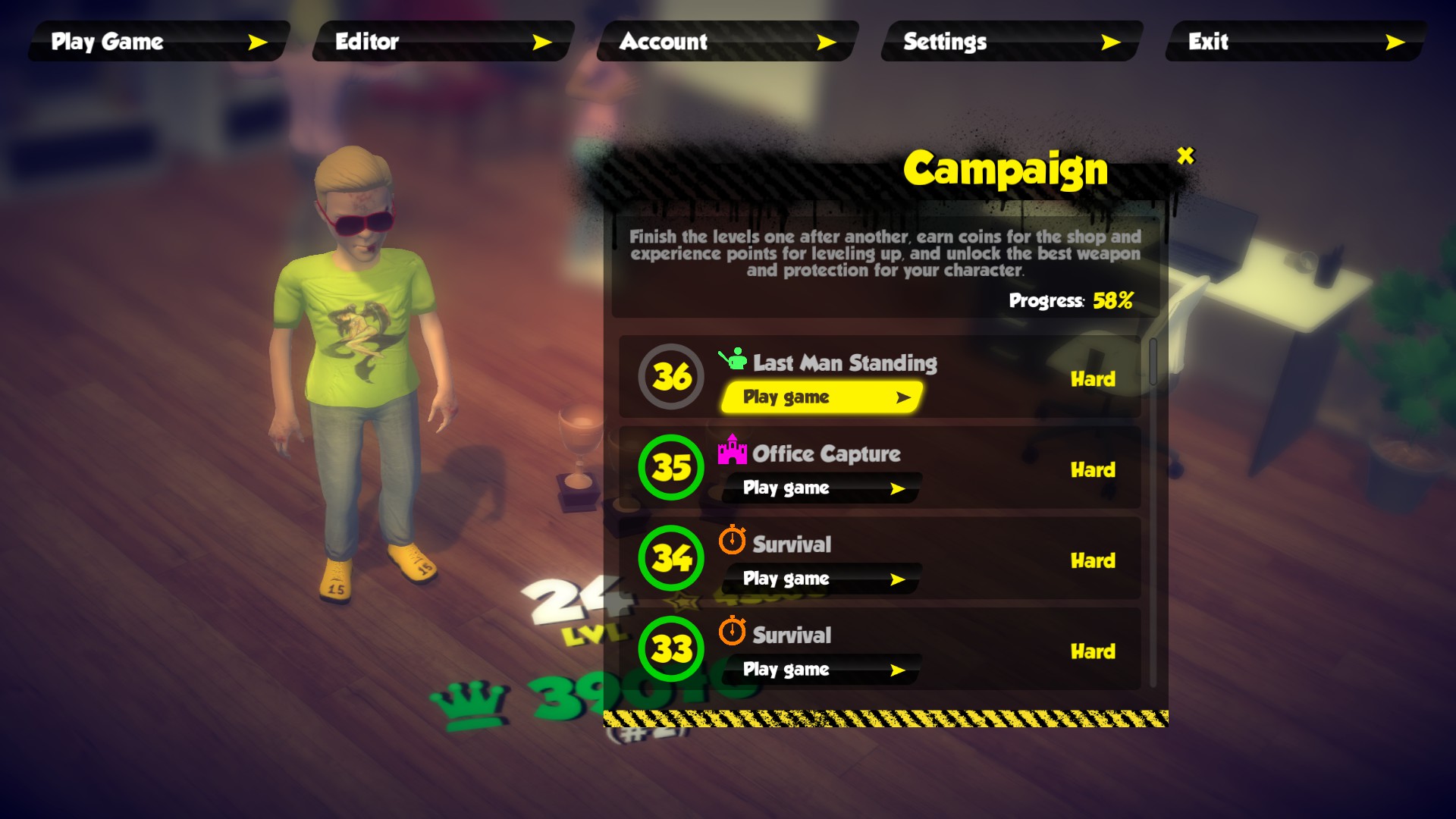
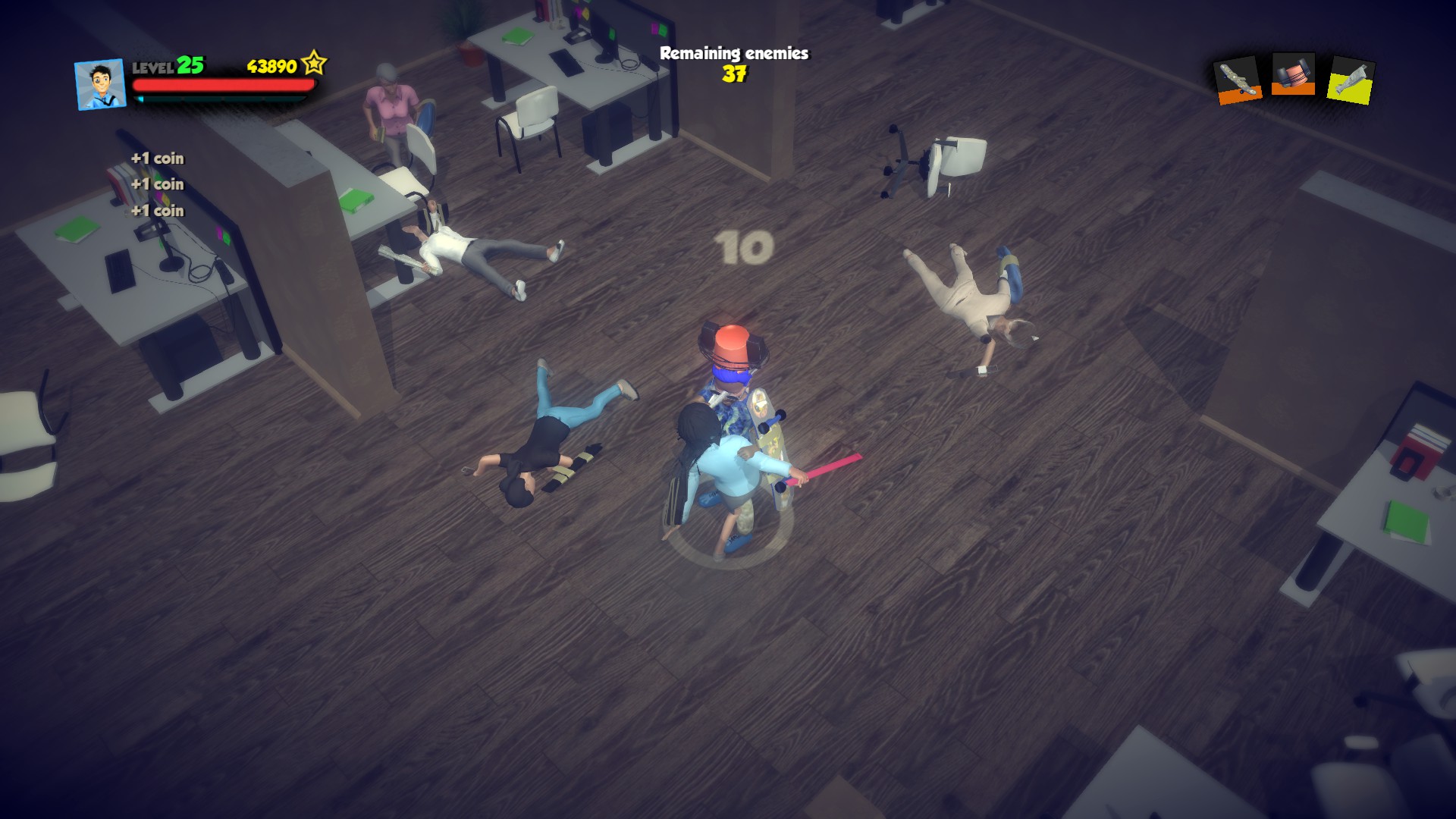
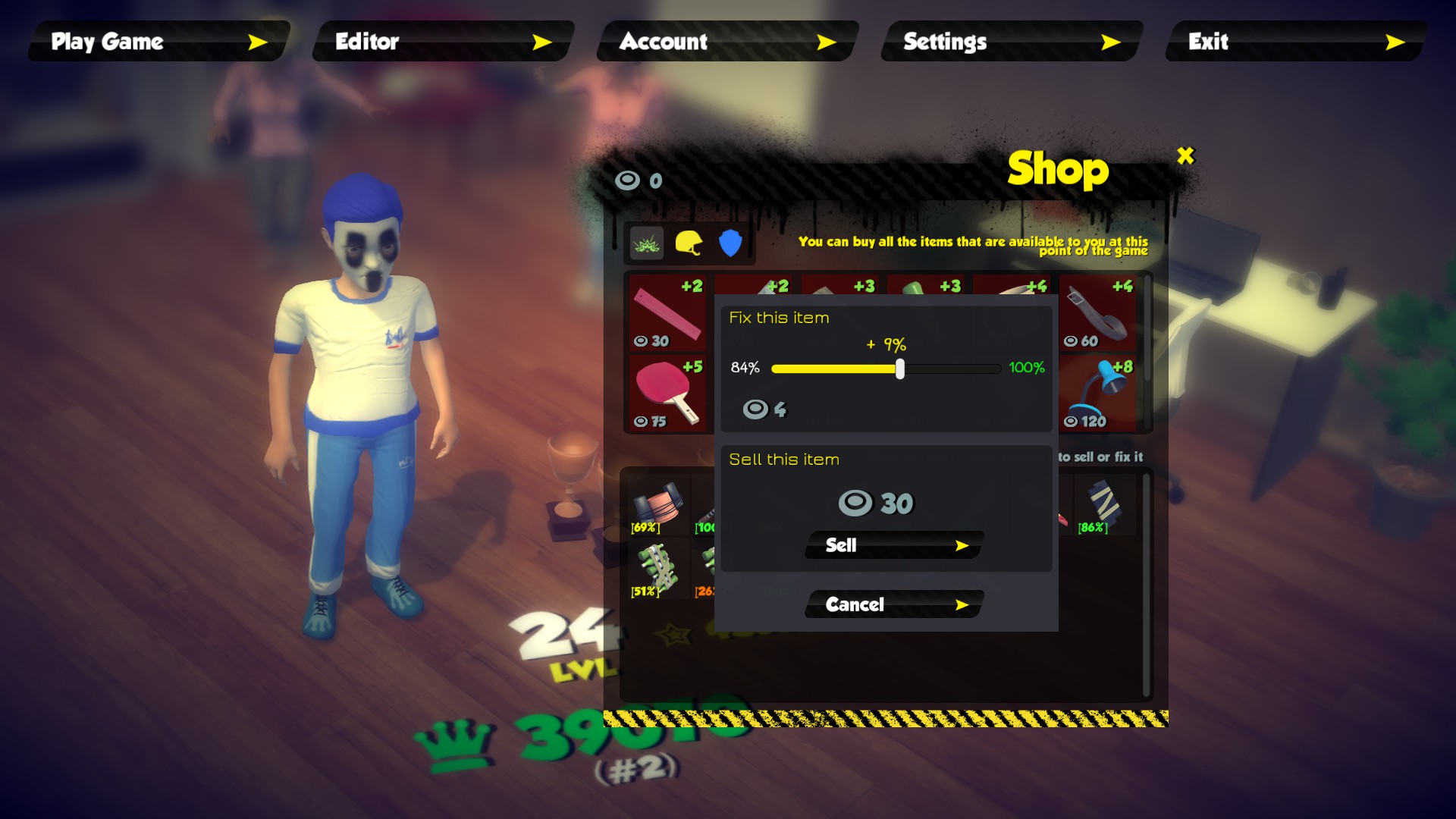
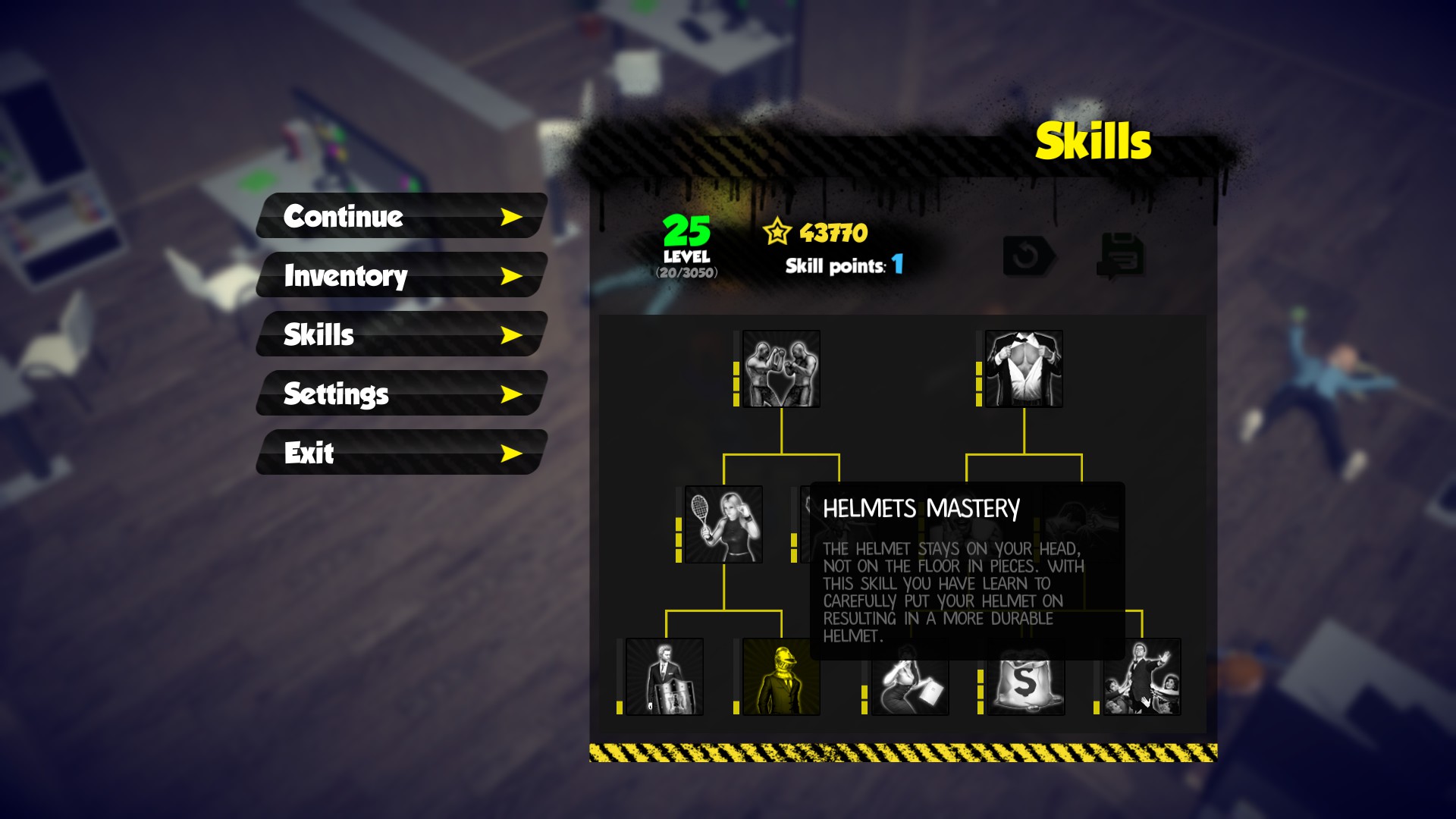
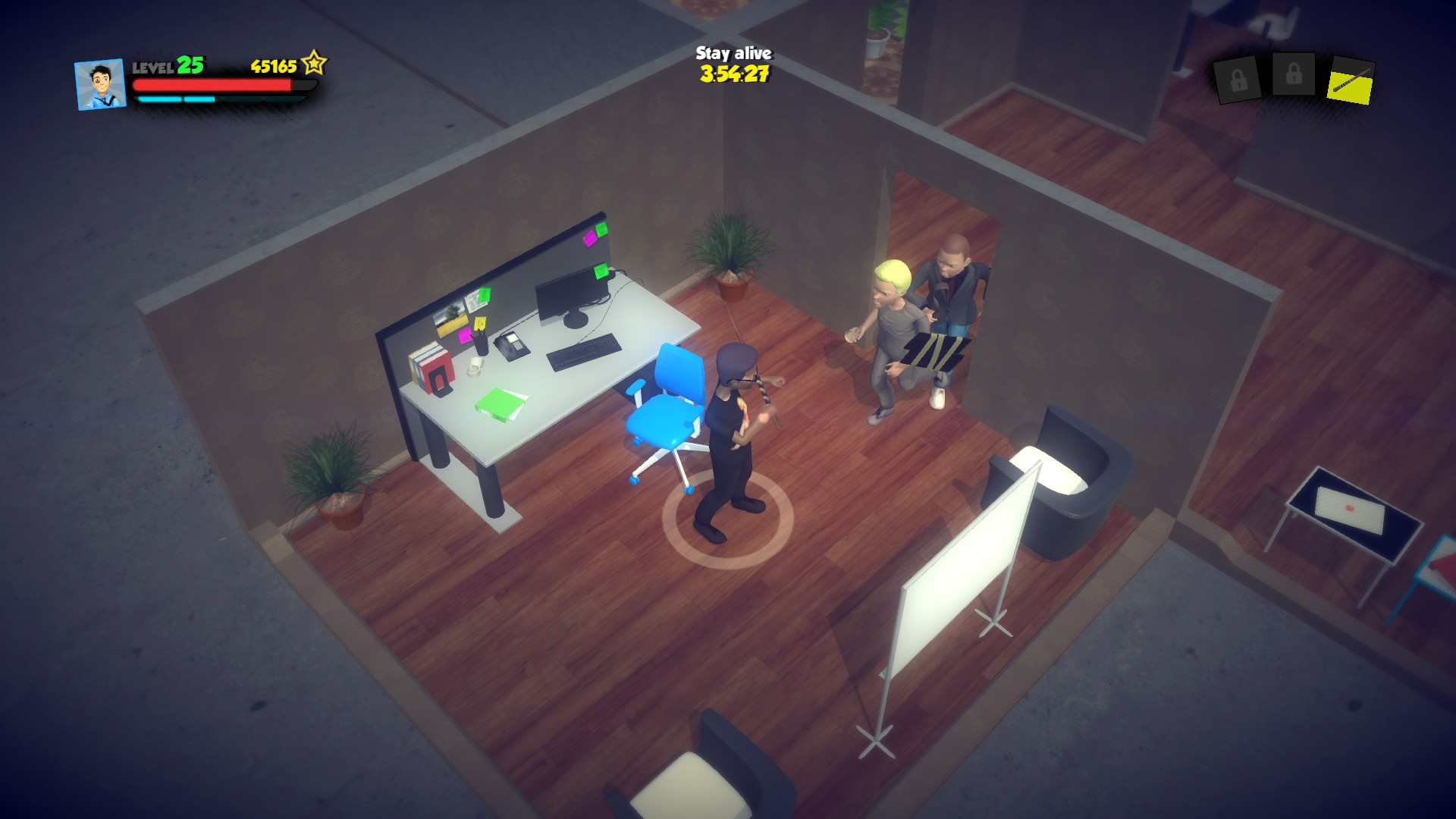
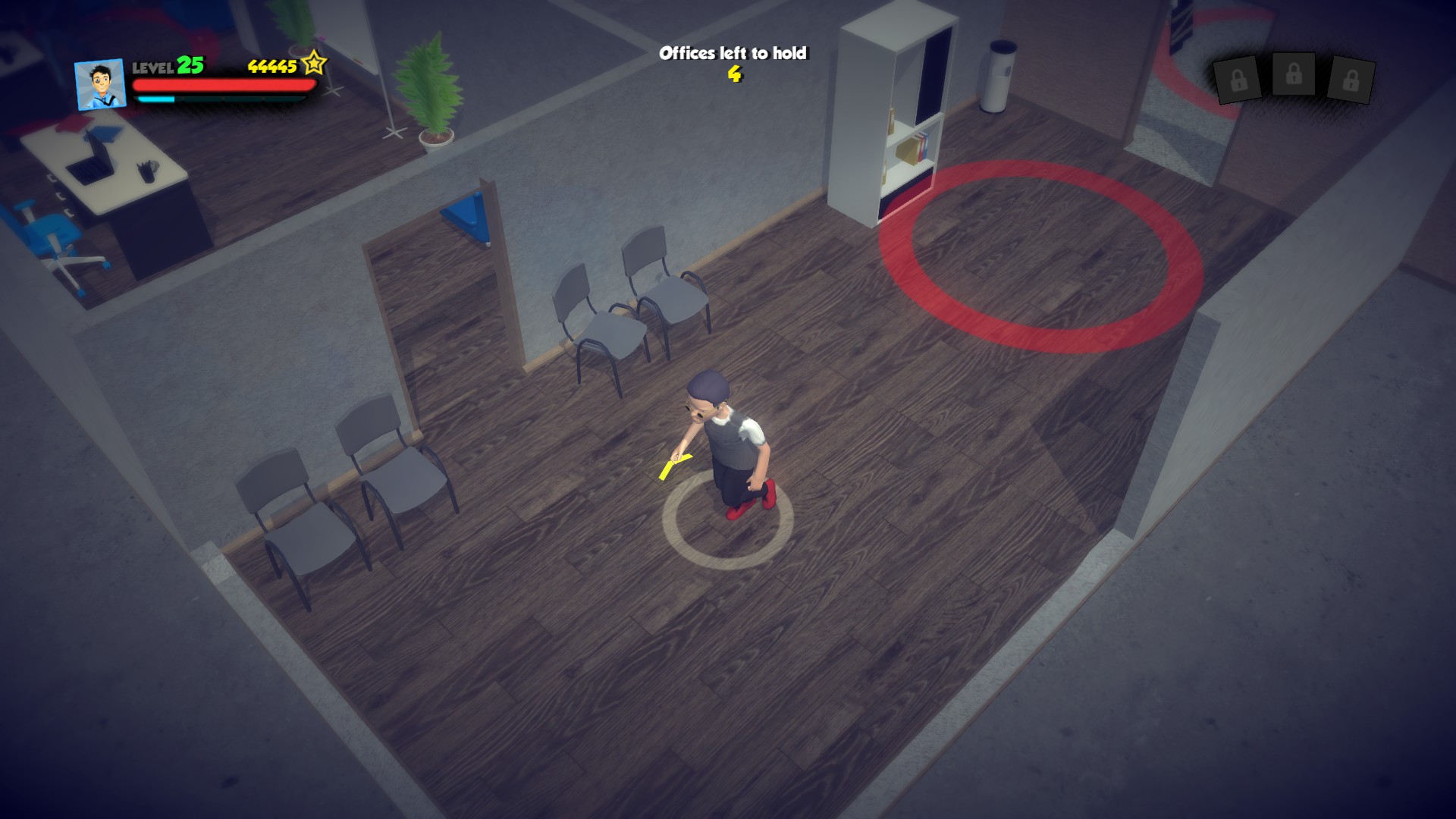
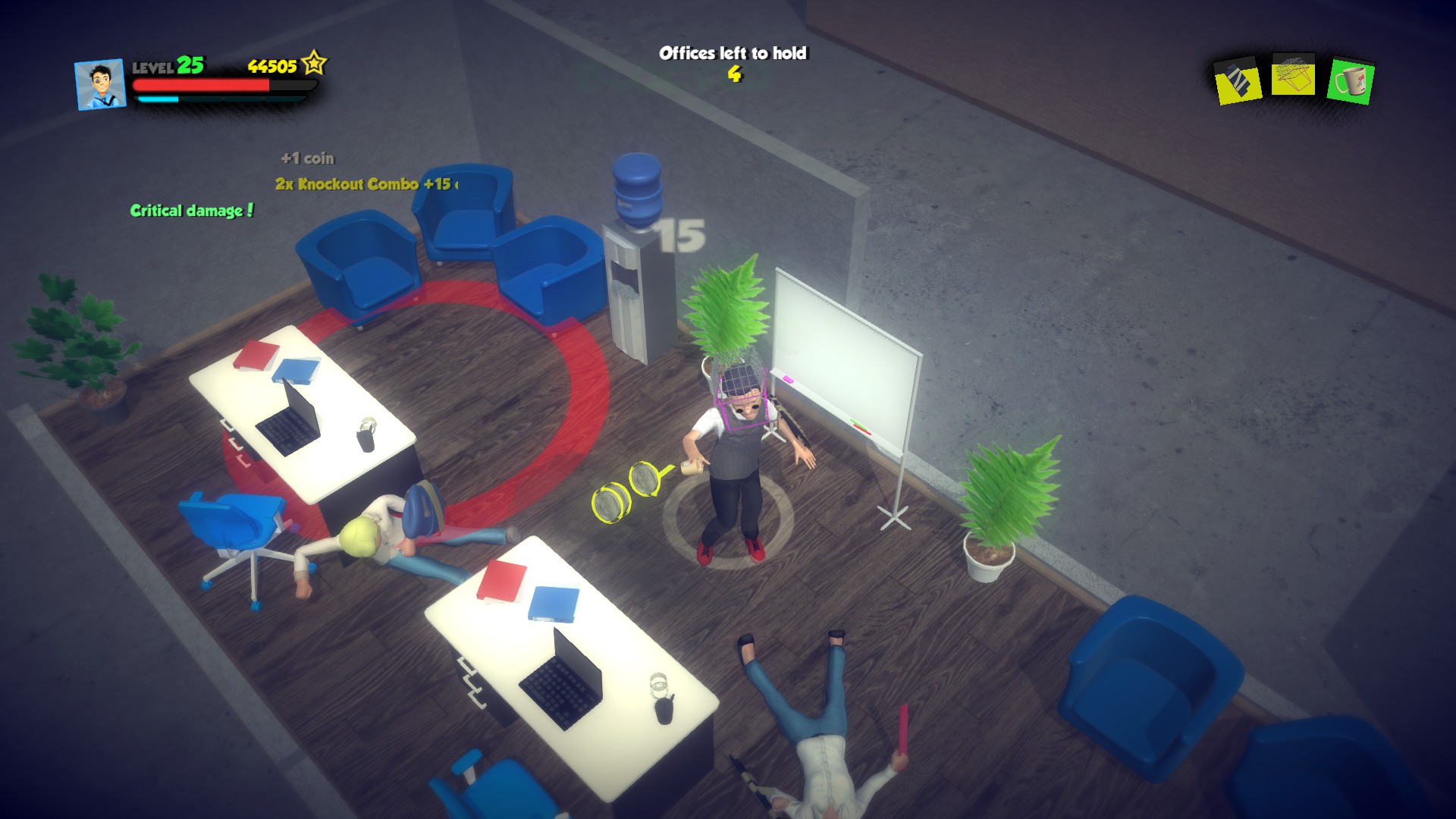
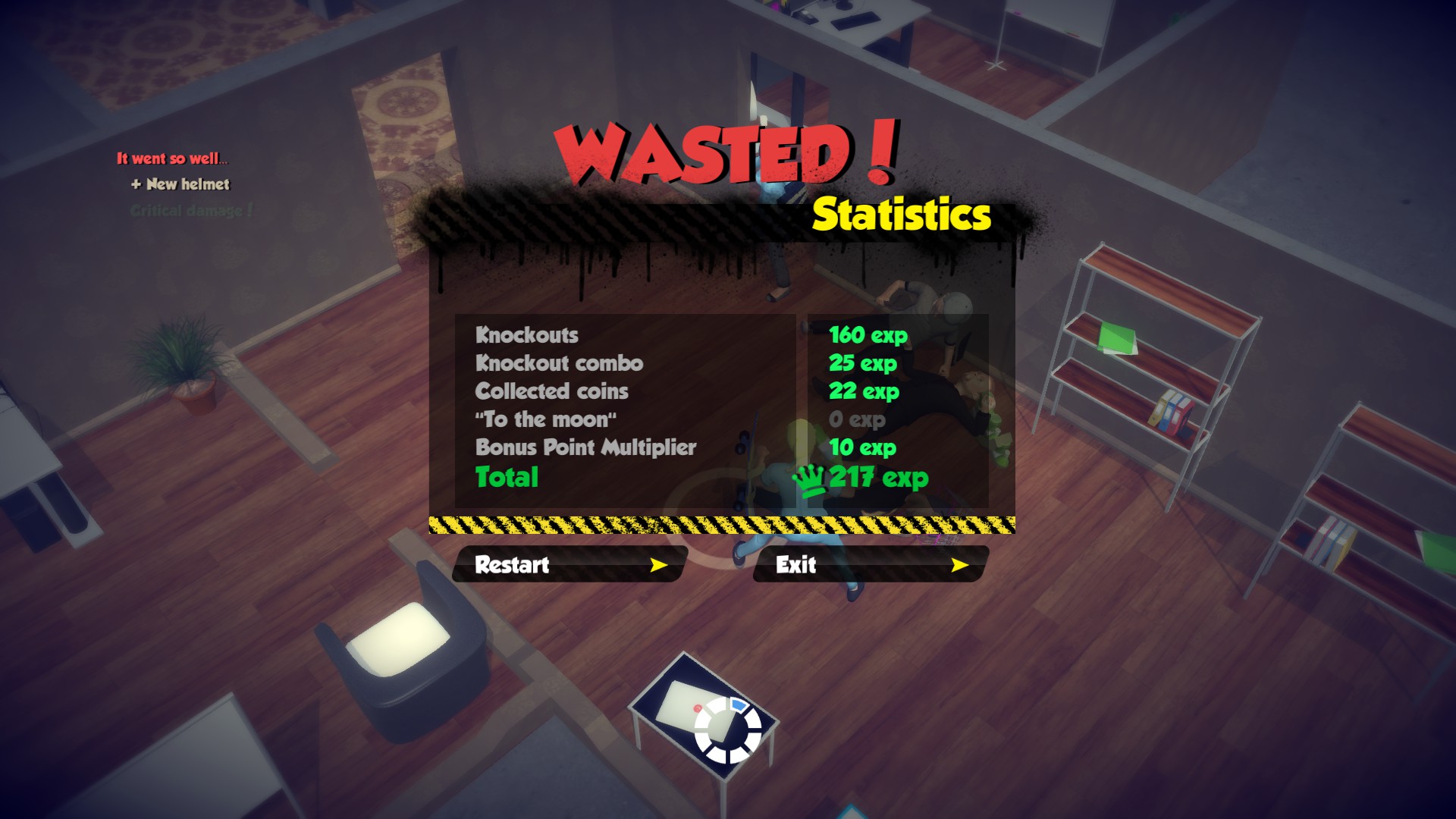
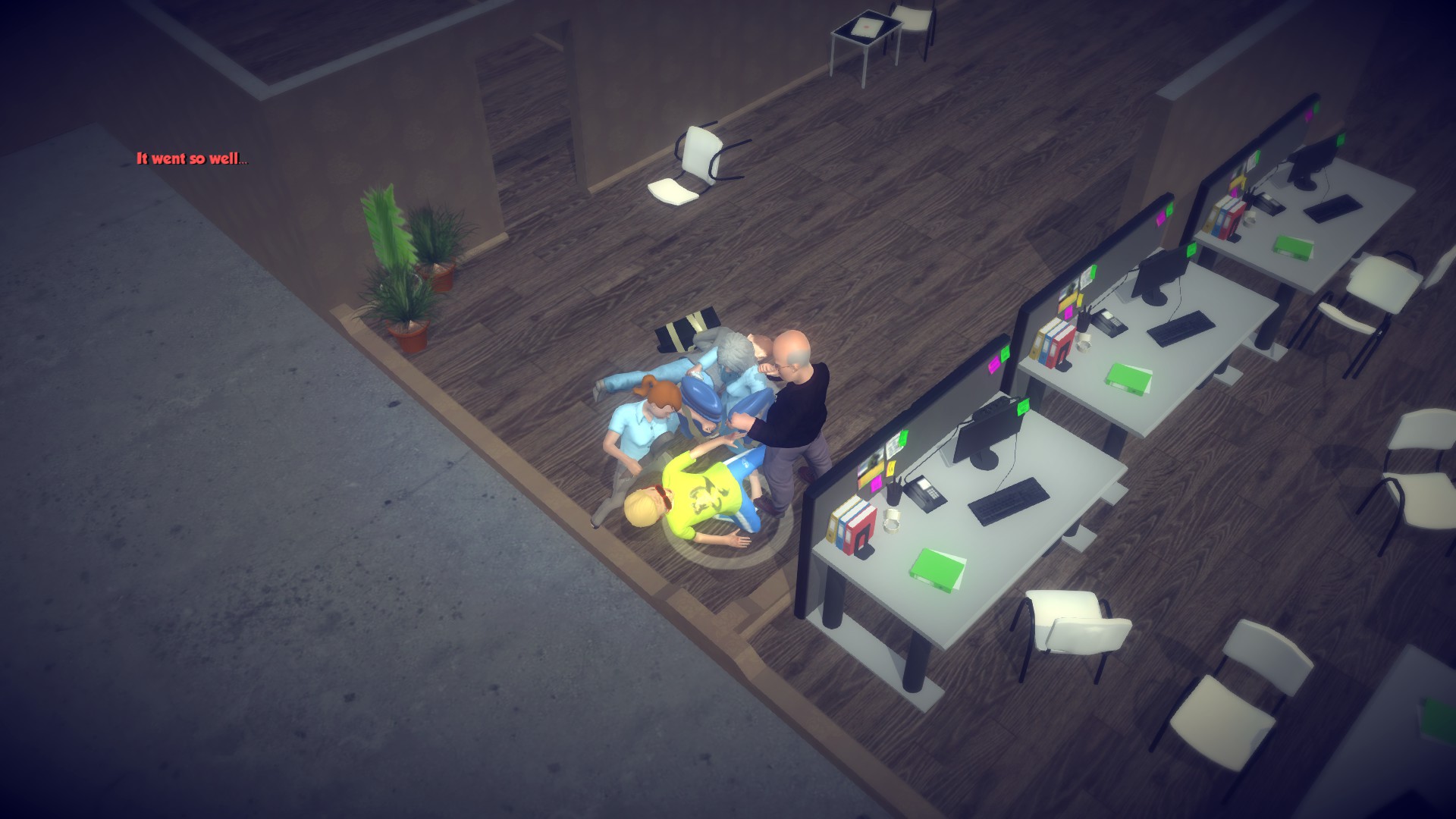
Office Battle, developed and published by Black Lime Studio, is a compact indie brawler that transforms the everyday workplace into a chaotic spectacle of improvised combat. It begins with a humorous premise familiar to anyone who has ever endured office boredom or frustration—what if the break room, cubicle farm, and copy machine battleground became literal battlegrounds? Instead of pushing paper or submitting reports, employees let loose with fists, chairs, keyboards, filing cabinets, and anything else within arm’s reach. The game does not attempt realism or subtle satire; instead, it leans wholeheartedly into absurdity, offering a caricatured vision of corporate life where grievances are settled through slapstick violence rather than passive-aggressive emails. That tongue-in-cheek foundation gives the game an immediate sense of identity and establishes expectations from the start. The core gameplay centers on fast, simple brawling mechanics designed to create messiness rather than technical precision. Players move through office-themed arenas completing objectives—knocking out coworkers, surviving waves of increasingly aggressive employees, collecting scattered items, or outlasting time-based challenges. The controls are intentionally straightforward, reducing combat to movement, striking, picking up objects, and swinging makeshift weapons. Instead of emphasizing combos, parries, or strategic timing, the game thrives on unpredictability. Weapons break suddenly, physics send objects flying in unintentionally comedic directions, and enemy behavior can shift from sluggish to alarmingly determined. The result is a constant barrage of improvised moments, where victories feel lucky, ridiculous, or earned purely through persistence. It embraces chaos as entertainment, and many of its funniest moments arise not from deliberate design but from the engine reacting unexpectedly to player actions. Progression adds a light layer of structure to the mayhem. Completing matches rewards players with currency and unlocks, which can be used to purchase new characters, power-ups, and weapons that alter survivability or offensive capability. These upgrades never deepen the combat system in a transformative way, but they do provide steady motivation to continue pushing through battles and improving performance. The game understands that its appeal lies in seeing what comes next—what new item might be thrown into the mix, how many opponents can occupy a cramped office hallway, or how survivability changes when new stats are applied. The treadmill of small rewards helps sustain momentum even when missions begin to feel familiar. Visually, Office Battle adopts a minimalist, low-poly art style that pairs well with its exaggerated concept. Character models resemble blocky action figures, and their stiff, frantic animations contribute unintentionally to the humor, making every punch or clumsy weapon swing look like a child smashing toys together. The environments mimic generic workplace layouts—rows of desks, storage areas, meeting rooms, and water coolers—yet they are arranged with open space and destructible objects to prioritize gameplay movement. Colors remain bright and readable, supporting the frenetic action rather than cluttering the screen. Sound effects add personality too, especially the exaggerated impact noises that reinforce the comedic exaggeration of office supplies being used like medieval weaponry. Nothing about the presentation is lavish, but its consistency supports the tone, allowing the absurd violence to remain center stage. Where Office Battle begins to show strain is in long-term engagement. Because combat prioritizes silliness over mechanical refinement, the novelty can fade once players understand how encounters tend to unfold. Enemy AI fluctuates wildly between passive wandering and sudden aggression, sometimes creating pacing issues within missions. Environmental design, while functional, can feel repetitive, as most arenas rely on similar room structure and object placement. The weapon system, though amusing at first, does not introduce enough variety to meaningfully change playstyle after extended sessions. Technical hiccups—such as objects clipping, delayed hit registration, or unpredictable physics reactions—can produce laughs, but they can also result in unintentional difficulty spikes. The more time spent with the game, the clearer its limitations become. Yet criticizing Office Battle for lacking depth risks missing the point. This is not a competitive fighting game, a detailed simulation, or a narrative-driven experience. It is a low-cost, intentionally silly diversion built around brief bursts of entertainment, ideal for players who want something mindless, chaotic, and humorous. Its strongest moments occur when the player stops trying to optimize and instead embraces the ridiculous premise—sprinting through a cubicle maze while being chased by furious coworkers armed with staplers, watching chairs ricochet in unpredictable arcs, or surviving a fight by hurling office trash cans with desperate improvisation. That ability to generate spontaneous comedy is where the game proves its worth. Office Battle ultimately succeeds by understanding its scale and leaning into its comedic core. It offers a cathartic interpretation of corporate culture, one where workplace tension becomes literal melee chaos and everyday objects become instruments of exaggerated rebellion. While its mechanics, visuals, and structure lack refinement, they collectively support the absurdity that defines the experience. It may not be a game players sink dozens of hours into, but for those who appreciate quirky indie experiments, slapstick physics, and the joy of controlled disorder, it delivers a short, unapologetically goofy distraction—one that captures the fantasy of quitting the office grind in the most explosive way possible. Rating: 7/10
Expand the review